Posted on Apr 30, 2021, 1:24 am
#21
Quote from: Serilium on April 30, 2021, 01:39:51 AMdamn, people on this forum really not that great at math. you literally divide tibia length by femur length in either inches or cm. idk whats going on LOL
It aint rocket science folks 
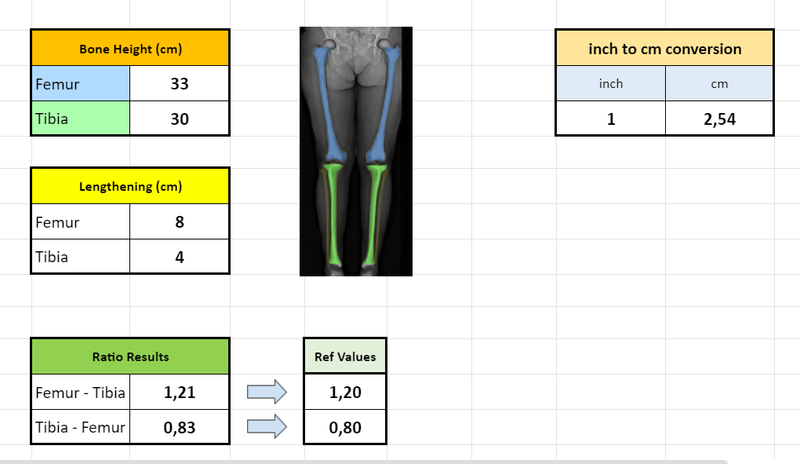
Many people don't know how to simple calculate the femur - tibia or tibia - femur ratio.
For the lazy 

Quote from: Ozzi6557 on April 30, 2021, 09:35:10 AMMy tibia is longer than the femur.
tibia 39 cm.
femur 36 cm.
That's why I have to wait for stryde to come back. It would look really weird if I’ll do tibia.
It's not. Do a full body EOS scan and you will see that it is not longer
Barring some extreme medical deformity, all humans femur are longer than tibia
False statement. There is not "many" people who have longer tibia than femur. You are either mixing up the numbers or your doctor is an idiot. I'll just safely assume you are mixing up your numbers, all orthopedic surgeons know femur is longer than tibia. Effectively no one has a longer tibia than femur. If you do then you are genetically messed up in more ways than just your legs.
It can appear longer, but is not.
You need an EOS scan. I will give you 1000$ in wire transfer if your tibia is actually longer than femur. Because it is not 🙄
Quote from: Ozzi6557 on May 01, 2021, 05:24:05 AMI agree with you that most people have a femur longer than the tibia. But you can not say that everyone is like that. My doctor is one of the most famous in the world, and he's probably not an idiot, there are dozens of people here in the forum who did the surgery on him.
"most" people is an understatement, it is probably more than 99.99999% of people who DON'T have a longer tibia than femur (meaning, their femur is longer). If the average tibia/fem ratio is 0.80 with a standard deviation of 0.03, then 3 standard deviations up would be 0.89 (tibia shorter than femur), which would be the top 0.15% (99.7% is 3 standard deviations coverage centered at 0.80), and 4 standard deviations up would be 0.92 (tibia still shorter than femur), which would be the top 0.0005% (99.99% is 3 standard deviations coverage centered at 0.80), and 5 standard deviations up would be 0.95 (again, tibia still shorter than femur), which would be the top 0.00003% (99.99994%% is 3 standard deviations coverage centered at 0.80), which at this point is the 5-sigma threshold for scientific observations to become a discovery.
At this point it is 1 in 3.5 million people who have a 0.95 tibia to femur ratio, and the tibia is STILL shorter than the femur.
The 6th standard deviation above the mean would be an astronomical number, and even then it is still not more than 1, it is 0.98. You'd need to hit the 7th standard deviation which would be much much much higher than 1 in 3.5 million to achieve a ratio of greater than 1, which would mean the tibia is longer than the femur.
For all purposes and intent, a longer tibia than femur is not natural and doesn't occur in more than 99.9999% of normal humans.
Why do I care enough to type all this? I don't, I am just bored and like math and have nothing to do. *shrugs*. Nothing personal Ozzi lol. 

References:
https://pubmed.ncbi.nlm.nih.gov/26398436/
https://en.wikipedia.org/wiki/68%E2%80%9395%E2%80%9399.7_rule
https://blogs.scientificamerican.com/observations/five-sigmawhats-that/#:~:text=So%2C%20what%20does%20five%2Dsigma,about%201%20in%203.5%20million.
Quote from: Serilium on May 01, 2021, 05:44:45 AM"most" people is an understatement, it is probably more than 99.99999% of people who DON'T have a longer tibia than femur (meaning, their femur is longer). If the average tibia/fem ratio is 0.80 with a standard deviation of 0.03, then 3 standard deviations up would be 0.89 (tibia shorter than femur), which would be the top 0.15% (99.7% is 3 standard deviations coverage centered at 0.80), and 4 standard deviations up would be 0.92 (tibia still shorter than femur), which would be the top 0.0005% (99.99% is 3 standard deviations coverage centered at 0.80), and 5 standard deviations up would be 0.95 (again, tibia still shorter than femur), which would be the top 0.00003% (99.99994%% is 3 standard deviations coverage centered at 0.80), which at this point is the 5-sigma threshold for scientific observations to become a discovery.
At this point it is 1 in 3.5 million people who have a 0.95 tibia to femur ratio, and the tibia is STILL shorter than the femur.
The 6th standard deviation above the mean would be an astronomical number, and even then it is still not more than 1, it is 0.98. You'd need to hit the 7th standard deviation which would be much much much higher than 1 in 3.5 million to achieve a ratio of greater than 1, which would mean the tibia is longer than the femur.
For all purposes and intent, a longer tibia than femur is not natural and doesn't occur in more than 99.9999% of normal humans.
Why do I care enough to type all this? I don't, I am just bored and like math. *shrugs*. Nothing personal Ozzi lol.
References:
https://pubmed.ncbi.nlm.nih.gov/26398436/
https://en.wikipedia.org/wiki/68%E2%80%9395%E2%80%9399.7_rule
https://blogs.scientificamerican.com/observations/five-sigmawhats-that/#:~:text=So%2C%20what%20does%20five%2Dsigma,about%201%20in%203.5%20million.
So Femurs are typically longer then Tibias.
By design it would seem Tibias are shorter for a reason (mechanically). Would lengthening them and ultimately changing the ratio In favour of the Tibia place the body at a disadvantage?
You must be logged in to post a reply.