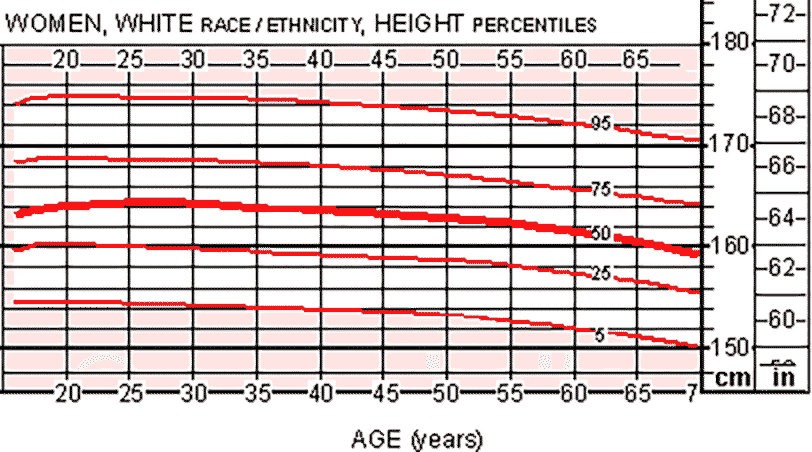
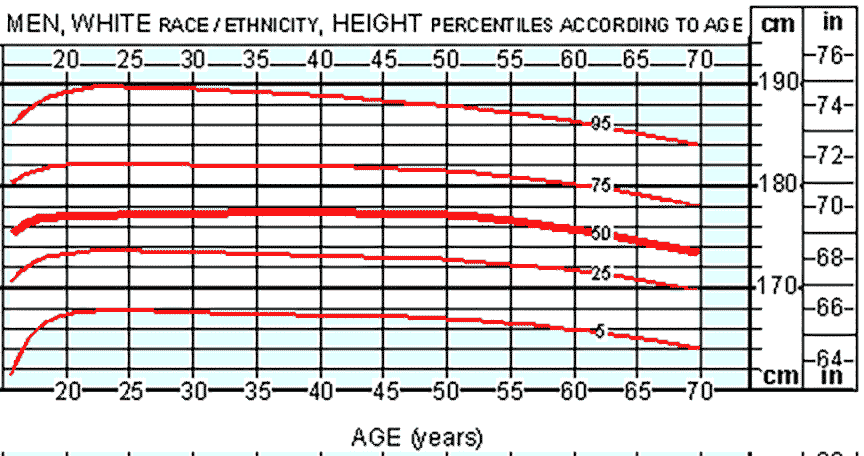
Quote from: CaptainAmerica on November 04, 2018, 03:17:27 AMhttps://www.cdc.gov/nchs/data/series/sr_03/sr03_039.pdf
https://i.imgur.com/UCIM0aE.png
Official stats from the CDC. Since it's entirely plausible that someone in the US could live in an area that is 90%+ white, I will be calculating with nums from the 20-39 non-hispanic white stats.
mean: 70.1 inches (5'10.1")
standard deviation: stdError*sqrt(n) = 0.11*sqrt(715) = 2.94
So we can say that height is normally distributed with a mean of 70 inches and a standard deviation of 3 inches.
http://www.muelaner.com/wp-content/uploads/2013/07/Standard_deviation_diagram.png
On this graph, σ(sigma) means standard deviation. Notice 68.2% of people will fall within one standard deviation, so that is 5'10+-3, 6'1 and 5'7.
Now, we want to see which jump has bigger area on this graph (5'6" to 5'8", 5'8" to 5'10", or 5'10" to 6') because that would mean that you would have the biggest "jump" and would become "taller" than more people in the population.
We can do this with normcdf(lower bound, upper bound, 70, 3).
For 5'6 to 5'8 the area is: 16.1%
For 5'8 to 5'10 the area is: 24.75%
For 5'10 to 6' the area is: 24.75%
Bonus intervals:
5'3 to 5'6: 8.1%
5'10 to 6'2: 40.87%
5'6 to 5'10: 40.87%
(notice the biggest jumps are the ones that are closer to the mean, this makes sense, there are a LOT of people close to the mean in the 5'8-6ft range).
What these percentages mean is, relative to each height, this is the percentage of more people you will be taller than after gaining height. So if you went from 5'6 to 5'8 you would now be taller than 16.1% of the males you would have encountered previously.
So to answer the question in the OP: Relatively 5'8 to 5'10 and 5'10 to 6' are equivalent jumps if we look at this from a PURELY statistical point of view.
I would say MORE important than area "jumps" is simply lying within about one single standard deviation of height, which would be the 5'7-6'1 line. Being within one standard deviation of a norm usually means you have become, incredibly average and usual, there is absolutely nothing uncanny or exceptional about a standard deviation. So for example, take someone who is 5'4 (2 standard deviations away) and becomes 5'8 (a little less than one standard deviation), even though that's only a 23% increase relative to the population, in reality he just went from being the shortest guy in a room of 50 males, to only being the shortest guy in a group of 4 males. That's a huge change in perception. Also, something similar happens to people going from 5'6 to 5'10, 5'6 to 5'10 is just slightly over a standard deviation away and 5'10 ls the mean. That means you go from being the shortest person in a group of 10 males to on average, being taller than half of males. That's another HUGE change in perception.
On a side note, from looking at the CDC stats, it's pretty interesting to note that their 30-39 sample population was 1/3 of an inch taller than their 20-39. The sample sizes were kind of small though (<1000), so it could just be error (or maybe, heights are actually starting to decline slightly in response to poor sleep/diets/hormones?). That may not sound like a lot, but in statistics a difference in even 1/3 of an inch on the mean can lead to significant effects IRL, heck, even one inch. Note that Germany is regarded as having an average male height of ~5'11 and America an average male height of ~5'9, and Germans are perceived to be "giants" because of this 2 inch difference. Something else I found interesting was that the 20-39 asians were 8/10ths of an inch taller than the 40-59 asians. Probably representing immigrants vs first generation asians (Could be diets and better health, or could just be immigration from different regions, could even be both).
Very interesting perspective. I agree that it's more about lying within one single standard deviation.
I just would like to add the for Asians (like you and me), I believe we'll be taller than more Asian men with 5'6"-5'8" jump than 5'8"-5'10". This is because there are more Asian men in that range.