What's better, internal methods such as the PRECICE nail ( https://www.nuvasive.com/procedures/limb-lengthening/precice-system/ aka an intramedullary nail), or external methods such as Modular Rail System ( https://smith-nephew.com/en-us/health-care-professionals/products/orthopaedics/modular-rail aka LON) , or Taylor Spatial Frames ( https://en.wikipedia.org/wiki/Taylor_Spatial_Frame aka external frames)
Well we have a study for it!
https://www.ncbi.nlm.nih.gov/pmc/articles/PMC8706718/
n=35, but with 39 procedures
-"Besides the long period of time in the frame, the most frequent adverse effects of external fixators include pin-site infections; implant loosening and frame destabilization; and problems with regeneration, such as premature consolidation, non-union or malunion, limited range of motion (ROM), and joint stiffness "
Is this not stuff we've talked about before? But something I hadn't considered was implant loosening and frame destabilization. Ouch! Does anybody here want to give themselves a non-union or a malunion? Probably not. Limited ROM and joint stiffness makes sense, since those frames are bulky.
-"Using intramedullary growing nails avoids some of these issues, but other serious complications, such as deep infections and the breakage of locking screws and the nail itself, may appear more frequently"
But hold on! Look at the studies(there are 4) this point is referencing! They are using LATN, or the problem has already been fixed, or it simply doesn't apply to us!
Study 1: "We lengthened 9 tibial segments over a nail to reduce the time in the external fixator in 5 patients with constitutional shortness."
See, it's LATN. Which means it does not apply to the PRECICE nail, a fully internal method.
Study 2: "26 PRECICE nails in 24 patients. 2 nails initially failed to function. Premature consolidation in 1 patient was resolved with a re-osteotomy, classified as a non-implant-associated obstacle. 2 nails broke during the consolidation phase, in 1 case due to a fatigue failure along the welding seam. The other nail broke at the connection between the lengthening unit and the extension rod when the patient fell accidentally."
4 nails had problems, none of which were infections. Additionally, this was the first iteration of the PRECICE nail! PRECICE 2.2 resolved all of these problems! Like I mentioned previously, the PRECICE 2.2 nail is the most up to date! It no longer has welding seams, which the first one had. Similarly, "The strength of the PRECICE 2 is up to 4 times stronger than PRECICE 1"! "Furthermore, the driveshaft connection strength has been increased 3 times more than PRECICE 1, which will reduce the risk of nail mechanism failure when a patient produces too much bone, which can result in premature consolidation, which arrests the lengthening process. In short, the PRECICE 2 permits greater lengthening with a stronger nail, a stronger drive shaft..."(Source: https://paleyinstitute.org/centers-of-excellence/stature-lengthening/the-precice/#/) ! The point is, these problems have already been resolved.
Study 3: "34 posttraumatic limb lengthening patients (femoral: 30, tibial: 4) were included from January 2010 until April 2019."
These are trauma patients, not cosmetic or LLD patients. This study is using the Fitbone, not PRECICE.
"Conclusion: Limb lengthening with a motorized lengthening nail for posttraumatic LLD is a relatively safe and reliable procedure."
So what's the deal?
"Compared with idiopathic LLD, posttraumatic patients are more likely to sustain complications when undergoing lengthening surgery due to pre-existing complicating factors, e.g., scare tissue, joint stiffness, dormant infection, skin issues, etc. "
Nobody on this forum is a trauma patient. As confirmed by this study, trauma patients are more likely to sustain complications, duh, but we are not trauma patients! Because we are specifically cosmetic patients, why do we care if this does not effect us?
We are cosmetic patients, so why are we so worried about hematomas that trauma patients get? Are lengthening delays something specific to an internal nail? NO. It's a bigger problem with external fixators, as mentioned in the original study. Sepsis? Again, we are not trauma patients with a dormant infection! Screw migration? Once again, our bones were not shattered in a car accident like many of these trauma patients! Where else in the literature is a screw migration this common!? And are we going to pretend that only internal nails use locking screws?
Study 4: "The Precice intramedullary limb-lengthening system has demonstrated significant benefits over external fixation lengthening methods, leading to a paradigm shift in limb lengthening."
So why is this study pertinent if it repeats what many others have said--Internal nails are better than external fixation?
"Hip and knee ROM was maintained and/or improved following commencement of femoral lengthening in 44 patients (60%) of antegrade nails and 13 patients (38%) of retrograde nails."
So hip and knee ROM either got better, or stayed the same, in over half of the 92 patients? That's pretty good, but does anyone refute the idea that some joint or muscle stiffness is to be expected when lengthening? Is that not why we do PT and stretch? So what's the concern here?
"Minor implant complications included locking bolt migration and in one patient deformity of the nail, but no implant failed to lengthen and there were no deep infections. Three patients had delayed union, five patients required surgical intervention for joint contracture. "
Key word: Minor. No implant failed to lengthen, and there were no deep infections? What's the problem? Now I'm not going to downplay 3 delayed unions and 5 joint contractures, that's a risk with all LL, but why are we acting like LON or external frames are any better? Why are we acting like it's unique to the PRECICE nail? It's not.
I'm going to leave the following quote from the study here:
"This study confirms excellent results in femoral lengthening with antegrade and retrograde Precice nails."
So we can say that the original problem of "deep infections and the breakage of locking screws and the nail itself, may appear more frequently" does not or no longer applies to us, except in the most exceptionally rare of cases. But again I ask, is this specific no internal nails? NO! All surgeries have risk involved, but some methods are safer than others, like using the PRECICE nail over external fixators.
-"The adverse effects of the therapy were observed and analyzed. The highest total rate of problems was noted in the TSF and MRS groups."
So NOT the IMN/PRECICE group.
-"At the pin sites of those in these groups, superficial infections were observed in five patients (29%) and two patients (18%), respectively."
Superficial, yes, but that shouldn't be ignored. Still, it gets even worse...
-"Moreover, one patient in the TSF group (6%) expressed painful heterotopic intramuscular ossifications in the pin site places."
Who would've thought having wires strewn through your leg like some patchwork quilt would hurt...
-"We found obstacles after the application of each method, including delayed consolidation in the IMN group (one patient; 9%), frame destabilization (two patients; 18%) and pre-consolidation (one patient; 9%) in the MRS group, and bone bending (two patients; 12%) in the TSF group."
Again, I'm not going to deny that there's risks involved. There are ALWAYS risks with ANY surgery. But I'll take having a delayed consolidation over bone bending any day! Delayed consolidation is just that, needing more time for the callus to form. But pre-consolidation will require another osteotomy in order to correct and allow lengthening. Which are you choosing?
-"Serious complications were fracture post frame removal (one patient; 9%; Figure 2) and malunion union (one patient; 9%) in the MRS group, two fractures post TSF removal (12%), and hardware failure—broken IMN and regenerate—in one patient (9%; Figure 3)"
Now you may read the "hardware failure" with the broken IMN and regenerate and think, "Well, the PRECICE/Internal nails must be far more dangerous!" Well, read further...
-"The patient did not follow the recommendations and went on a hike in mountains and started full weight bearing before the regenerate consolidation"
What the F?? Are we going to blame the nail, or the patients stupidity!?
Clearly, the PRECICE nail is far superior to the other two methods!
So all in all we have...
IMN (n = 11)
Problems None
Obstacles 1 (9%)—delayed consolidation
Complications 1 (9%)—hardware failure (broken nail and regenerate fracture)
One instance of delayed consolidation, NOT non-union, but just a DELAYED consolidation. I'm not saying that is good, but that is entirely different than a malunion! And a hardware failure which was the fault of the PATIENT, not nail.
MRS (n = 11)
Problems 2 (18%)—pinsite/superficial infection
Obstacles 2 (18%)—frame Destabilization
1(9%)—pre-consolidation
Complications 1 (9%)—malunion
1 (9%)—fracture post removal
And people argue that LON/Modular Rail System is safe?
TSF (n = 17)
Problems 5 (29%)—pin site/superficial infection
1 (6%)—heterotopic intramuscular ossifications in pin places
Obstacles 2 (12%)—bone bending
Complications 2 (12%)—fracture post removal
I prefer to not have my bone bend or fracture my newly formed bone right after frame removal. Pin site infections don't sound pleasant either, and painful intramuscular ossifications sound...terrifying. Do you agree?
-"Similarly, Black et al., who analyzed the results of femoral lengthening in skeletally mature children with congenital diseases, indicated a decreased “Category-I” complication rate (pin-track infection and mild joint contractures, which require minimal intervention) in the motorized nail group in comparison to the circular frame group"
tldr, internal nails are better than external frames.
-"who combined a monoliteral external fixator with intramedullary nail splinting and compared it with the Ilizarov method"..."Using this combined technique, the other authors confirmed its usefulness in the lengthening of the femur and tibia, although the rate of deep infections remains high, from 2.4% to 15%"
LON = 2.4% to 15% of deep infections. No thanks!
-"In our material, superficial pin-site infections were noted in seven cases of external fixators (25%), while deep infections were not observed. The main advantage of TSF over monolateral external fixators is the possibility to correct axial deformations simultaneously with bone distraction. This computer-assisted method is a valuable tool for bone distraction with the correction of complex deformities.
So maybe TSF is better than LON if you have a axial deformation? But who cares, we are cosmetic patients!
-"Fracture of the regenerate remains a significant complication of bone lengthening. Four events of fractures occurred: two in the TSF group, one in the MRS group, and one in the IMN group with concomitant nail fracture."
Again, the IMN fracture was due to the PATIENT not following the Doctor's instructions, not the nails fault!
-"The evident disadvantages of an external fixator are the presence of a frame, which hinders daily activity and exercise with the need for everyday pin-site cleaning, and a second surgical procedure for hardware removal. In the case of IMN, removal is not obligatory. Additionally, some doubts concern the possibility of magnetic resonance imaging (MRI) subsequently to IMN application. Despite this, it has not been tested for compatibility in the MRI environment and did not receive approval from the Federal Drug Agency (FDA); several studies have tested the safety from this aspect. Gomez et al. did not find negative effects, such as heating, elongation, and migration forces, acting upon this implant in 1.5T and 3T fields [40]. Nevertheless, they concluded that 3T protocols should be avoided in patients who are still undergoing lengthening or if lengthening is planned in the future. "
Make of this what you will. Maybe you don't *need* to get the IMN removed, but you probably *should*. I definitely will. There have been anecdotal reports of patients feeling much better after rod removal, for a few reasons. 1) The bone has a certain degree of 'bounce' and 'elasticity' to it, which a nail interrupts. The nail also adds excess weight, making your legs feel heavier. Additionally, the nail causes a stress point at where it's locked, which *could* increase the possibility of fracturing it from other physical activities. Nothing definitive here, but most Doctors are going to recommend you remove the nails, so you probably should.
-"Firstly, the small size of the examined groups is evident. We decided to only include patients with congenital etiology of the femur length deficiency. Post-infected and post-traumatic cases and patients with malignancies were excluded due to adverse influence on the femur lengthening process and the potentially higher frequency of complications."
Which again I have to state, we are cosmetic patients, not trauma patients. So this limitation does not apply to us.
-"The second limitation is the retrospective nature of this study and the lack of randomization. However, the compared implants were only available during a certain period (MRS and IMN). The design of the study with the selection of patients who could be treated with all implemented methods assessed in this research can correspond to the randomization."
This limitation is hardly a limitation, and doesn't change the outcome anyways. IMN over external fixators.
Conclusion:
-"In conclusion, our study indicates IMN as the most valuable method of treatment for femoral length discrepancy without axial deformity. The strongest advantages were noted in the lowest rate of adverse effects (especially problems and obstacles) and faster regenerate organization with a return to full weight bearing, but a potentially more invasive procedure of hardware removal. We believe that IMNs and TSFs are currently the best options for simple femur bone lengthening in adolescents with congenital disorders. However, there is a need to confirm our findings in a larger group of patients with the randomization protocol. "
Do we have axial deformity? NO, we are cosmetic patients. Is hardware removal a factor with LON? YES. Are external fixation, such as LON and External Frames, associated with fracturing the new bone regenerate? YES. Are we adolescents with congenital disorders/axial deformity? NO.
Let's post this quote from the abstract again:
"This study indicates that IMN is a more valuable method of treatment for femoral length discrepancy without axial deformity than MRS and TSF in complication rate and indexes of lengthening and consolidation."
Case settled! The Intra-Medullary Nail/PRECICE is superior to the Modular Rail System/LON and to the Taylor Spatial Frames/external frames.
What method of Limb Lengthening is best? Internal Nail vs LON vs External Frames
Related Medical Evidence Peer-Reviewed
Too much conjecture and bro-science on this forum. Hopefully this thread will put all the nonsense to rest with actual facts and logic.
Sure internals are better, but external still has a lot of benefits. Superficial infections are annoying but not a huge deal. Bone bending will only happen after external fixation if the doctor is a moron and removes it too early or doesn't have the will power to not cave to patient pressure about removing the frame early.
Wow a whole 39 cases of non-controlled anecdotal data. I'm finally convinced that reaming your bone marrow is the best option now. 
Quote from: KiloKAHN on June 27, 2023, 02:25:03 AMSure internals are better, but external still has a lot of benefits. Superficial infections are annoying but not a huge deal. Bone bending will only happen after external fixation if the doctor is a moron and removes it too early or doesn't have the will power to not cave to patient pressure about removing the frame early.
What are the benefits of externals?
Price? Sure, I can't argue against that. Weight bearing? Eh, maybe. There are full weight bearing nails on the market like the BetzBone. Nuvasive is launching a new weight bearing nail/STRYDE replacement by the end of the year. As soon as that happens, then what benefit is left? External frames on tibias to avoid splitting the patella? Now your Tibia:Femur ratio is off, a significant predictor in knee and hip arthritis.
Superficial infections and bone bending are not the only complications with external methods. LON has a 2.4% to 15% chance of deep infections. Malunion, serious infections, frame destabilization, and pre-considation shouldn't be hand-waved. Granted, a pre consolidation isn't the worst thing in the world, but it would suck having to do an additional surgery for another osteotomy. Price goes up, anesthesia isn't good for you, and more trauma to the local area = more scarring. Nothing about fracturing your brand new bone regenerate is good.
I guess you could argue "Well if your Doctor just would've done this...", but then we get trapped in a circular argument that'll go nowhere. Plus, how do you know what that Doctor did or didn't do? Are you assuming that in all cases of bone bending and fractures, it was due to the Doctor being pressured by the patient? That is a massive assertion without any evidence.
Quote from: Medium Drink Of Water on June 27, 2023, 03:29:26 AMWow a whole 39 cases of non-controlled anecdotal data. I'm finally convinced that reaming your bone marrow is the best option now.
I assume you are joking, but for anybody else reading, the peer reviewed study was published in the Journal of Clinical Medicine. This was not anecdotal data. While the study did not have a control group, it was a retrospective study ( https://www.ncbi.nlm.nih.gov/pmc/articles/PMC4093311/ See here for more). The original study did a good job in their inclusion criteria, starting with n=186.
(1) femoral length deficiency caused by congenital diseases without any axial deformities and (2), independently of the finally applied treatment, the technical possibility of use of each of the analyzed methods. Exclusion criteria were established as <10 and >18 years old and no technical possibility to apply any of the tested methods in the retrospective assessment, e.g., a too-narrow medullary canal for nail implantation, axial deformity of the femur bone before the treatment, acquired femoral length deficiency due to malignancy, infection, and/or fracture.
Why do we care about trauma patients!? Why do we care about congenital patients!? We are cosmetic patients! We are looking at otherwise healthy bone, that just so happens to have a discrepancy. While it would've been nice to have tibia patients included so that we could have a larger sample size, it is not the end of the world.
There is a paper on cosmetic limb lengthening that you can read here: https://www.ncbi.nlm.nih.gov/pmc/articles/PMC7342054/
The total number of patients was 795.
It shows that the longest average lengthening was achieved with LATN technique (7.6 cm (3.5 to 12.0)), while the shortest was with ILN (5.6 cm (1.7 to 8.0)).
Moreover, the ILN group had the fewest problems, obstacles, and complications per patient.
This means that the ILN has the lowest risk of complications, but if you want to lengthen your leg more than 8 cm, you would need external fixation.
Quote from: NailedLegs on June 27, 2023, 07:46:52 AMWhat are the benefits of externals? External frames on tibias to avoid splitting the patella? Now your Tibia:Femur ratio is off, a significant predictor in knee and hip arthritis.
That ratio is determined by the amount lengthened, not by the device used.
QuoteSuperficial infections and bone bending are not the only complications with external methods.
I never had a single infection in five months. And neither did the other patient there who promoted leaving the pinsites alone. An infection is determined by bacteria, and the patient's environment and behavior determine whether they get into the wounds or not. It's not random chance.
Bone bending can be fixed by making minor adjustments to external frames through the course of lengthening. If bones are bent at the end it's because either the patient or doctor messed up.
QuoteLON has a 2.4% to 15% chance of deep infections. Malunion, serious infections, frame destabilization, and pre-considation shouldn't be hand-waved. Granted, a pre consolidation isn't the worst thing in the world, but it would suck having to do an additional surgery for another osteotomy. Price goes up, anesthesia isn't good for you, and more trauma to the local area = more scarring. Nothing about fracturing your brand new bone regenerate is good.
Premature consolidation is determined by bone growth, which is determined by genes and nutrition. How is that the frame's fault?
QuoteI guess you could argue "Well if your Doctor just would've done this...", but then we get trapped in a circular argument that'll go nowhere. Plus, how do you know what that Doctor did or didn't do? Are you assuming that in all cases of bone bending and fractures, it was due to the Doctor being pressured by the patient? That is a massive assertion without any evidence.
The combination of what you and your doctor do is mostly going to determine the outcome. It's not something to be dismissed. How much of an impact did the devices even have on the outcomes in this study anyway? Correlation is not causation, and LL issues aren't due to random chance. Distilling things down to numbers can often obscure the truth rather than reveal it.
Quotethe peer reviewed study was published in the Journal of Clinical Medicine. This was not anecdotal data. While the study did not have a control group, it was a retrospective study ( https://www.ncbi.nlm.nih.gov/pmc/articles/PMC4093311/ See here for more). The original study did a good job in their inclusion criteria, starting with n=186.
Yeah, not technically anecdotatl data, but not much better really. No control means there's no claim of cause and effect. The researchers have no idea what caused the problems and are not claiming to, which is the standard for scientific journals like this.
The sample size is tiny, and many problems happend to either one or two patients. One case of delayed consolidation in the whole study, and it happened to an internal patient, which is 9% of them in the study. Zero for external patients. This does not mean internals result in delayed consolidation 9% of the time and that there's zero risk of it for external patients. Generalizing anything from this study is not justified.
And LON means Lengthening Over Nails, an approach to LL which involves placing a fixed internal nail into the intermedullary canal during the same surgery as the breaking of the bone and installation of an external device. LON does not mean monorails. You can do LON with TSF, Ilizarov, or monorails, or a rope tied to your foot with a donkey pulling on it.
Quote from: Maison on June 27, 2023, 09:06:18 AMThis means that the ILN has the lowest risk of complications, but if you want to lengthen your leg more than 8 cm, you would need external fixation.
No, it does not mean that.
"A little learning is a dangerous thing."
-Alexander Pope, 1709
Quote from: Medium Drink Of Water on June 27, 2023, 04:43:26 PMThat ratio is determined by the amount lengthened, not by the device used.
Yes, but I was specifically talking about doing external frames on tibias only, which has been suggested on this forum. If you only do your tibias, you will skew your T:F ratio which is a significant predictor in hip and knee arthritis. ( https://pubmed.ncbi.nlm.nih.gov/26398436/ )
Quote from: Medium Drink Of Water on June 27, 2023, 04:43:26 PMI never had a single infection in five months. And neither did the other patient there who promoted leaving the pinsites alone. An infection is determined by bacteria, and the patient's environment and behavior determine whether they get into the wounds or not. It's not random chance.
So your argument is "Well I didnt get an infection, so its not a real risk"? Just because YOU didn't get an infection, does not mean OTHERS will not. That's why we use statistics so we can understand the RATE that a problem may occur at.
That is a bath faith argument. For someone that claimed the studies used anecdotes, why are you using anecdotes?
Quote from: Medium Drink Of Water on June 27, 2023, 04:43:26 PMBone bending can be fixed by making minor adjustments to external frames through the course of lengthening. If bones are bent at the end it's because either the patient or doctor messed up.
"Bone bending and fracture: Decisions made about the timing for frame removal are based upon a number of factors, including x-ray appearances/ability to weight bear comfortably and time spent in frame. However, unfortunately, bones can still sometimes bend or fracture when the fixator is removed requiring further treatment and sometimes, further surgery."
( Source: https://foi.avon.nhs.uk/Download.aspx?did=26388&f=All%20About%20Frames-1.pdf Warning, the PDF automatically downloads for some reason! Do not click if you don't want to download it.)
The keyword is "HOWEVER". So while some of the risk can be mitigated, according to the NHS not all risk can be mitigated. Regardless, the fact remains that mistakes CAN happen with ANY surgery. This is something you must consider. Where in the literature do we see IMN nails causing fractures at the same rate of externals, besides patients not following their Doctor's instructions?
Quote from: Medium Drink Of Water on June 27, 2023, 04:43:26 PMPremature consolidation is determined by bone growth, which is determined by genes and nutrition. How is that the frame's fault?
I agree to a certain extent, but why did you ignore everything else? Why did you cherry pick premature consolidation(Which one could argue is worse than a delayed consolidation because you have to get another surgery to correct it.) and ignore serious infections? I already stated that a premature consolidation isn't the worst thing in the world.
Quote from: Medium Drink Of Water on June 27, 2023, 04:43:26 PMThe combination of what you and your doctor do is mostly going to determine the outcome. It's not something to be dismissed. How much of an impact did the devices even have on the outcomes in this study anyway? Correlation is not causation, and LL issues aren't due to random chance. Distilling things down to numbers can often obscure the truth rather than reveal it.
So what evidence do you have to support the contrary? NONE. That's the point of this thread. You have no evidence to support your claims, and I'm revealing the lies and falsities spewed on this forum. This is about harm reduction. This is about giving people all of the information so that they can determine for themselves what the best course of action is. At the end of the day, it's up to you to determine what method you use to lengthen. At least do it being completely informed. It's called informed consent.
Quote from: Medium Drink Of Water on June 27, 2023, 04:43:26 PMYeah, not technically anecdotatl data, but not much better really. No control means there's no claim of cause and effect. The researchers have no idea what caused the problems and are not claiming to, which is the standard for scientific journals like this.
So you admit that you lied or were being intentionally misleading in your original statement? I'm glad we are making progress then.
Ilizarov or TrueLok vs IMN(Fitbone) https://www.ncbi.nlm.nih.gov/pmc/articles/PMC7535106/
"A decreased number of complications was noted with use of a motorized intramedullary nail compared with circular external fixation in pediatric patients undergoing femoral lengthening for congenital femoral deficiency. "
Discrepancy patients, NOT trauma patients.
Orthofix Limb Reconstruction System vs IMN(PRECICE) https://www.reachyourheight.com/wp-content/uploads/2018/03/2017-Herzenberg-Lengthening_With_Monolateral_External_Fixation.JPO_.pdf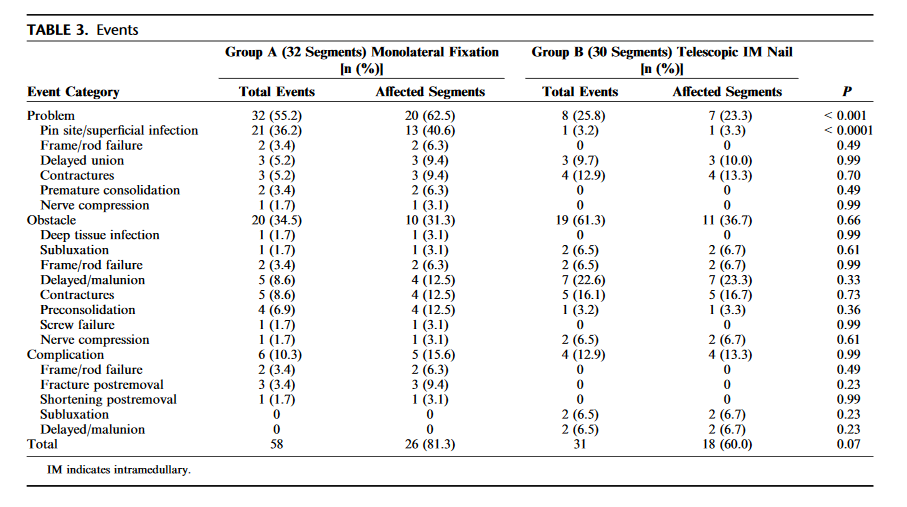
Here we can see a table of all the problems, obstacles, and complications that occurred. If you don't know, that is defined as "Difficulties that occur during limb lengthening were subclassified into problems, obstacles, and complications. Problems represented difficulties that required no operative intervention to resolve, while obstacles represented difficulties that required an operative intervention. All intraoperative injuries were considered true complications, and all problems during limb lengthening that were not resolved before the end of treatment were considered true complications."
In essence, the further down you go (Problem -> Obstacle -> Complication) the worse it is. Looking at true complications, we can see that frame/rod failure, fracture postremoval, and shortening post removal are problems with LON, but not IMN. Similarly, subluxation and delayed/malunion is a problem with IMN, but not LON. Why? Read below.
"Subluxation is always a risk in CFD patients who undergo lengthening procedures. With the external fixator, this is mitigated by spanning the knee with a hinged external fixator construct. With the IM lengthening nails, we rely on dynamic splinting in full ex-tension."
I have not read about a cosmetic Limb Lengthening patient getting a hinged external fixator construct in addition to their lengthening fixator. Does that mean they are at the same risk level of subluxation? That's up to you to research and determine, I can't say.
"In summary, we feel that the IM lengthening nail represents a significant advance in technology for CFD lengthening. The increased potential for knee subluxation must be guarded against by strict bracing protocols, and in cases of preoperative radiographic instability, pro-phylactic knee ligament reconstruction."
If Medium Drink Of Water can make the argument of "If bones are bent at the end it's because either the patient or doctor messed up.", then can't I make the same argument that subluxation is because the Doctor or Patient messed up?
"The first stage of knee subluxation is the development of a knee contracture; vigilant splinting is crucial"
So it's the Doctor's or Patient's fault in not monitoring for a contracture, which could prevent knee subluxation by splinting? See how this works both ways? Does that mean we can ignore subluxation like Medium Drink of Water ignores bone bending and fractures?
I understand questioning a retrospective study. Did you look at the other paper I replied to you with? ( https://www.ncbi.nlm.nih.gov/pmc/articles/PMC4093311/ ) But again I ask, what evidence do you have that shows the contrary? What evidence do you have that shows external fixators are better than intramedullary nails? And if you have that evidence, how are they better?
Quote from: Medium Drink Of Water on June 27, 2023, 04:43:26 PMThe sample size is tiny, and many problems happend to either one or two patients. One case of delayed consolidation in the whole study, and it happened to an internal patient, which is 9% of them in the study. Zero for external patients. This does not mean internals result in delayed consolidation 9% of the time and that there's zero risk of it for external patients. Generalizing anything from this study is not justified.
That's true, which is why it's important to maintain an open mind to new information. So again I ask, what evidence do you have that shows the contrary? What evidence do you have that shows external methods are superior to internal methods? I am not here proclaiming that internal methods have no faults or problems--they do. All surgeries carry some form of risk, but the purpose is to determine what's the safest. What method of limb lengthening will likely result in the best outcome? That is the question.
Quote from: Medium Drink Of Water on June 27, 2023, 04:43:26 PMAnd LON means Lengthening Over Nails, an approach to LL which involves placing a fixed internal nail into the intermedullary canal during the same surgery as the breaking of the bone and installation of an external device. LON does not mean monorails. You can do LON with TSF, Ilizarov, or monorails, or a rope tied to your foot with a donkey pulling on it.
That is correct.
Dr. Paley created the modern day LON method.
https://pubmed.ncbi.nlm.nih.gov/9378732/
So the creator of the modern day LON method states that the LON is outdated, and that the PRECICE nail is the most advanced in the world. Should we give any credibility to the Doctor that created the modern LON method? Should we say he's wrong, and that we should continue to use LON?
Notice how I've done my best to provide studies for my claims. You have not. I want to be proven wrong, because that's how we can learn. Why are we believing anecdotes and assumptions over studies and logic? I understand your hesitancy towards retrospective studies, so why haven't you provided anything that shows the contrary? I'm willing to take any kind of study you can provide--but you can't.
I want to make my final point clear. If you disagree, tell me why. This sums up my entire argument:
We are cosmetic patients wanting to increase our height. The most effective and safest way to do so is not with external fixators. Intramedullary nails, such as PRECICE 2.2, come with risks. No surgery is 100% safe. All prospective patients should understand what they are about to put their body through, all the pros and the cons.
Quote from: Medium Drink Of Water on June 27, 2023, 04:44:56 PMNo, it does not mean that.
"A little learning is a dangerous thing."
-Alexander Pope, 1709
According to that study...
Implantable lengthening nail had a mean complication rate of 0.02, which is lower than the four other methods. (0.2, 0.2, 0.1, 0.6)
Implantable lengthening nail had a mean obstacle rate of 0.23, which is lower than the other four methods. (1.5, 0.6, 0.7, 1.5)
Implantable lengthening nail had a mean problem rate of 0.16, which was lower than the other four methods. (0.7, 0.6, 1.1, 0.5)
It included a total of 11 studies, with a sample size of 795.
According to the study, an Implantable lengthening nail is safer than a Classic Ilizarov frame, hybrid advanced ring fixator, lengthening over nail, and lengthening and then nail.
What do you disagree with?
Quote from: Maison on June 27, 2023, 09:06:18 AMThere is a paper on cosmetic limb lengthening that you can read here: https://www.ncbi.nlm.nih.gov/pmc/articles/PMC7342054/
The total number of patients was 795.
It shows that the longest average lengthening was achieved with LATN technique (7.6 cm (3.5 to 12.0)), while the shortest was with ILN (5.6 cm (1.7 to 8.0)).
Moreover, the ILN group had the fewest problems, obstacles, and complications per patient.
This means that the ILN has the lowest risk of complications, but if you want to lengthen your leg more than 8 cm, you would need external fixation.
Thank you for posting this study.
You must be logged in to post a reply.