
Posted on Feb 13, 2015, 2:31 pm
#11
Does anyone know femur percentiles? I always felt that my femurs is where i lose the most height (my humerus is also correspondingly short).
Does anyone know femur percentiles? I always felt that my femurs is where i lose the most height (my humerus is also correspondingly short).
Quote from: NewHeights on February 13, 2015, 02:31:15 PMDoes anyone know femur percentiles? I always felt that my femurs is where i lose the most height (my humerus is also correspondingly short).
You can measure buttock-knee length (194)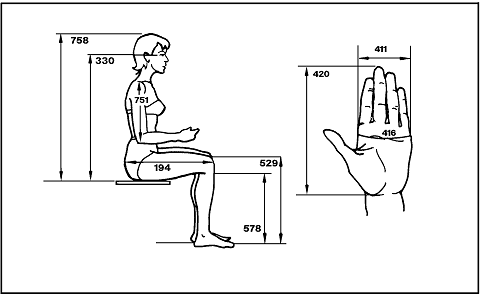
56.8 (22.4) 61.3 (24.1) 65.8 (25.9)
5th 50th 95th
The taller you are before surgery the better and you got a good starting height so 5cms will be pretty good for you, baggy pants will look good specially.
Quote from: Shor7Guy on February 14, 2015, 08:38:52 PMIDIOT.
Body Size of the 40-Year-Old American Male for Year 2000 in One Gravity Conditions
Woah there, buddy... I think you might have your head too high up the clouds:
QuoteData included in this document have been primarily measured on the ground (1-G environment)
QuoteHowever, to distinguish acceleration relative to free-fall from simple acceleration (rate of change of velocity), the unit g (or g) is often used. One g is the acceleration due to gravity at the Earth's surface and is the standard gravity
QuoteThe precise strength of Earth's gravity varies depending on location. The nominal "average" value at the Earth's surface, known as standard gravity is, by definition,[2] 9.80665 m/s2 (about 32.1740 ft/s2). This quantity is denoted variously as gn, ge (though this sometimes means the normal equatorial value on Earth, 9.78033 m/s2), g0, gee, or simply g (which is also used for the variable local value)
I like how you highlighted the word 'idiot' though.
Quote from: exclide on February 14, 2015, 10:09:43 PMWoah there, buddy... I think you might have your head too high up the clouds:
I like how you highlighted the word 'idiot' though.
lol
Quote from: exclide on February 14, 2015, 10:09:43 PMWoah there, buddy... I think you might have your head too high up the clouds:
I like how you highlighted the word 'idiot' though.
Height Increase - Stature increases approximately 3%.
Quote from: Shor7Guy on February 15, 2015, 12:28:19 AMHeight Increase - Stature increases approximately 3%.
...
QuoteWhere possible, guidelines are provided for relating these data to space flight acceleration regimes (from hypergravity to microgravity).
QuoteNotes for application of dimensions to microgravity conditions:
Anthropometric Changes in Weightlessness:
Height Increase - Stature increases approximately 3%. This is the result of spinal decompression and lengthening.
Quotea) Gravity conditions - the dimensions apply to a 1-G condition only. Dimension expected to change significantly due to microgravity are marked.
(Ok, I stop now)
OK thanks for your opinion guys!
You must be logged in to post a reply.