Quote from: heightiseverything on August 10, 2024, 04:57:47 PMIn your opinion, which method allows to minimize malalignment and knock knees? Taylor, LATN, LON, or internals like Precice? Or is it solely dependent on the technique used by the surgeon?
Tsf or any other hexapod on tibias (where else) is the only way to have a perfectly aligned bones, of course with an experienced doctor. Nothing else.
Femur lengthening and mechanical/anatomical axis angles
Quote from: Body Builder on August 10, 2024, 05:20:42 PMTsf or any other hexapod on tibias (where else) is the only way to have a perfectly aligned bones, of course with an experienced doctor. Nothing else.
What about femurs? I always thought tibias are going to lengthen straightly, as compared with femurs that lengthen into knock knees (valgum). Or maybe tibias tend to lengthen into varum, or vice versa?
Quote from: heightiseverything on August 10, 2024, 05:46:30 PMWhat about femurs? I always thought tibias are going to lengthen straightly, as compared with femurs that lengthen into knock knees (valgum). Or maybe tibias tend to lengthen into varum, or vice versa?
Always there msy be some malunion. For femurs I don't know if something can be done with internal nails. I think it can't.
Quote from: heightiseverything on August 10, 2024, 05:46:30 PMWhat about femurs? I always thought tibias are going to lengthen straightly, as compared with femurs that lengthen into knock knees (valgum). Or maybe tibias tend to lengthen into varum, or vice versa?
From my personal research - tibias lengthening may cause varum or valgum only if internal nail was bent due to excessive load OR tension in your muscles from one side. However, in ideal case if everything goes well tibia lengthening does not affect position of knees as the bone itself is straight and perpendicular to the ground when you stay so if it's kept straight - you're good.
Femur lengthening over internal nail will change the mechanical angle for sure. You may not get valgum only if you already had varum (and if it was caused by femur solely) initially. I've also read about cases in russian clinics where extra correction is performed once your lengthening is done. Correction is done by taking small part of your bone and changing it's angle a bit somewhere in the middle (it get's temporary fixated in this place with a metal plate afterwards) of bone to, let's say, direct femurs a bit more to outer side. Here's what I mean:
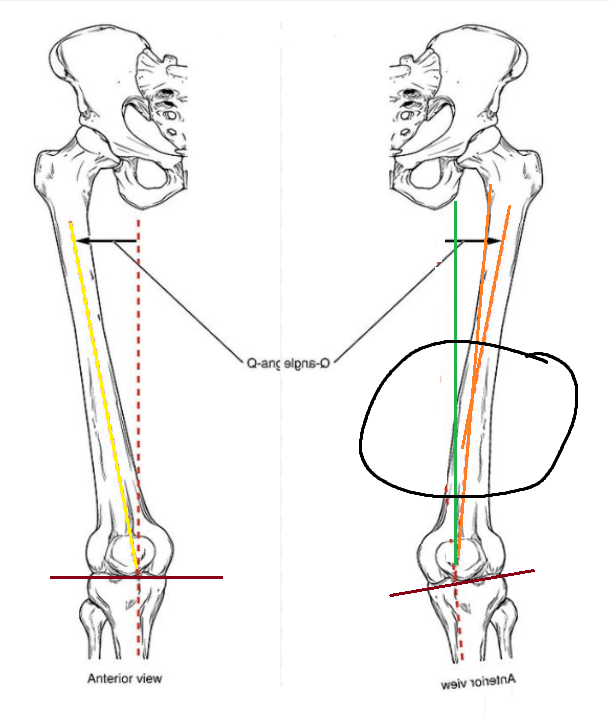
This is a big compromise because - yes, it will help with knock knees as the distance between your knees is restored, however:
1) your bone now get's two axis (right picture, orange lines) instead of one axis in a healthy bone (left image, yellow line). This means that place where two axis are crossed will always get excessive load.
2) Inner part of knee will also get an extra angle meaning that load will not be distributed correctly.
A person that is originally tall does not have this problem because even though they have longer femurs, their femur neck to femur itself angle is different. So the only way to restore original knees alignment for short person doing LL on femurs over internal nail would be to also do manipulation over the place where femur and femoral neck are connected to correct the angle there, however, I have not heard of such procedure in any clinics.
Quote from: Dragonheart on August 11, 2024, 02:09:31 AMFrom my personal research - tibias lengthening may cause varum or valgum only if internal nail was bent due to excessive load OR tension in your muscles from one side. However, in ideal case if everything goes well tibia lengthening does not affect position of knees as the bone itself is straight and perpendicular to the ground when you stay so if it's kept straight - you're good.
Femur lengthening over internal nail will change the mechanical angle for sure. You may not get valgum only if you already had varum (and if it was caused by femur solely) initially. I've also read about cases in russian clinics where extra correction is performed once your lengthening is done. Correction is done by taking small part of your bone and changing it's angle a bit somewhere in the middle (it get's temporary fixated in this place with a metal plate afterwards) of bone to, let's say, direct femurs a bit more to outer side. Here's what I mean:
This is a big compromise because - yes, it will help with knock knees as the distance between your knees is restored, however:
1) your bone now get's two axis (right picture, orange lines) instead of one axis in a healthy bone (left image, yellow line). This means that place where two axis are crossed will always get excessive load.
2) Inner part of knee will also get an extra angle meaning that load will not be distributed correctly.
A person that is originally tall does not have this problem because even though they have longer femurs, their femur neck to femur itself angle is different. So the only way to restore original knees alignment for short person doing LL on femurs over internal nail would be to also do manipulation over the place where femur and femoral neck are connected to correct the angle there, however, I have not heard of such procedure in any clinics.
What about if someone either has bow legs or knock knees? Could this malalignment cancel one or another, if at all, in full?
I am also wondering how does this malalignment reduce your height gain. Obviously, you lose some mm by lengthening along anatomical axis (due to the angle), but you must also lose even more due to the changing angle. Do you know if there is a formula for calculating how much the angle will change after lengthening along the anatomical axis for a certain amount of cm?
Quote from: heightiseverything on August 12, 2024, 10:07:26 PMWhat about if someone either has bow legs or knock knees? Could this malalignment cancel one or another, if at all, in full?
Bow legs situation might be improved by this lateral shift that happens after femur lengthening, however, everything depends on what actually causes bow legs in particular case. It might be due to the tibia that is not straight while your femur angles are ideal - in this case you'll just break the biomechanics even more.
Quote from: heightiseverything on August 12, 2024, 10:07:26 PMI am also wondering how does this malalignment reduce your height gain. Obviously, you lose some mm by lengthening along anatomical axis (due to the angle), but you must also lose even more due to the changing angle. Do you know if there is a formula for calculating how much the angle will change after lengthening along the anatomical axis for a certain amount of cm?
Well, anatomical axis and mechanical axis form a triangle where one angle is 90 degrees. So you can calculate height boost using any Hypotenuse Calculator if you have x-ray and know your angle and current femur length.
https://www.omnicalculator.com/math/hypotenuse
Angle α is 6 degrees ideally. C side (hypotenuse) is your femur length. B side is actual leg length that affects your height directly. We don't care about A so let it be auto calculated.
You can enter values above and then manipulate C side length (take your current length + desired lengthening). There's also a research saying that 10% lengthening adds lateral shift to the angle by 0.57 degrees (angle is decreased), so you can also recalculate angle α for your case so that B side is calculated properly with new C side length.
https://www.ncbi.nlm.nih.gov/pmc/articles/PMC5434350/
You must be logged in to post a reply.