
Posted on Oct 5, 2015, 11:50 pm
#1
Is there anybody over here with a lot of information about it who can tell us mire about this project?
Is there anybody over here with a lot of information about it who can tell us mire about this project?
I'd like to see any information on this.
There is some progress, perhaps it will be cosmetically available in 20-40 years or so but I couldn't say.
Quote from: Uppland on October 06, 2015, 09:50:58 AMThere is some progress, perhaps it will be cosmetically available in 20-40 years or so but I couldn't say.
takes too long
Longer than 20 or 40 years. Probably we will be too old by then.
Quote from: becometaller on October 06, 2015, 01:24:35 PMLonger than 20 or 40 years. Probably we will be too old by then.
Even if its possible in 5 years it will be a problem cuz it will be very expensive to regenerate all growth plates in the body
i use google translate to understand. if i am right. it is the soft bone in kids that has space to makr them tall. i think 20 yrs
It feels like 5 years away for real animal trials, if the background on research like this is accurate (I can't find published papers on this case, just news reports).
http://www.naturalheightgrowth.com/2014/11/01/video-alexander-teplyashins-laboratory-lengthening-legs-sheep-using-stem-cell-implants/
However, all the papers I've seen were just about mesenchymal stem cells used for bone/other regeneration. This is what some LL surgeons already do and call stem-cell therapy. The successful epiphyseal plate implantation still seems to be the main challenge.
Links like this paint a more distant picture:
https://www.wired.co.uk/article/lab-grown-bone-biomedical-engineering-osteoporosis-amputees
Quote"We add the bone putty to an anatomically correct, rigid living scaffold, that we made by 3D printing collagen," says Matthew Dalby, professor of cell engineering at the University of Glasgow, and one of the lead authors of the paper. "We put lots of cells in the body so it has a chance to integrate this new bone. We tell the cells what to do in the lab, then the body can act as a bioreactor to do the rest."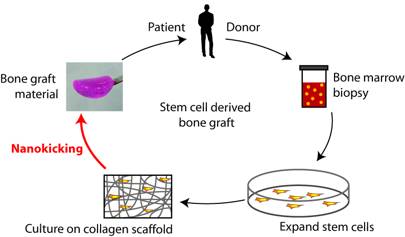
QuoteDalby speaks with earnest about how it can also help civilian and solider blast injuries, once it is established within the NHS. "All it takes is a few centimetres of bone to extend the length of a leg stump so they can wear a prosthetic," he explains.
I'm aware of how MSCs can differ themselves, and what they can create, but this doesn't seem much different or promising than what some CLL doctors already do to just stimulate bone growth.
Sadly, they never went into detail for this quote:
Quote"We are getting better at surviving but we have a lot of trauma injuries. In partnership with Sir Bobby Charlton’s landmine charity Find A Better Way, we have already proven the effectiveness of our scaffolds in veterinary medicine, by helping to grow new bone to save the leg of a dog who would otherwise have had to have it amputated."
Again, the situation could be better or worse than what I know. This is all casual investigating I'm doing on my own.
Quote from: myloginacc on June 29, 2018, 12:22:10 PMIt feels like 5 years away for real animal trials, if the background on research like this is accurate (I can't find published papers on this case, just news reports).
To me, if we believe the more optimistic sources, it always seems "right around the corner". Do you agree my friend?
But it's gonna take longer in reality...to be honest, I'd be really glad if my grandkids and their peers won't have to worry about height anymore.
The technology and ability is already there. It's just when will the incentive be there to make it speed up the process and make it worth doing?
You must be logged in to post a reply.