
I'm mostly just continuing from an older post.¹
Height Gains Over the Last 100 Years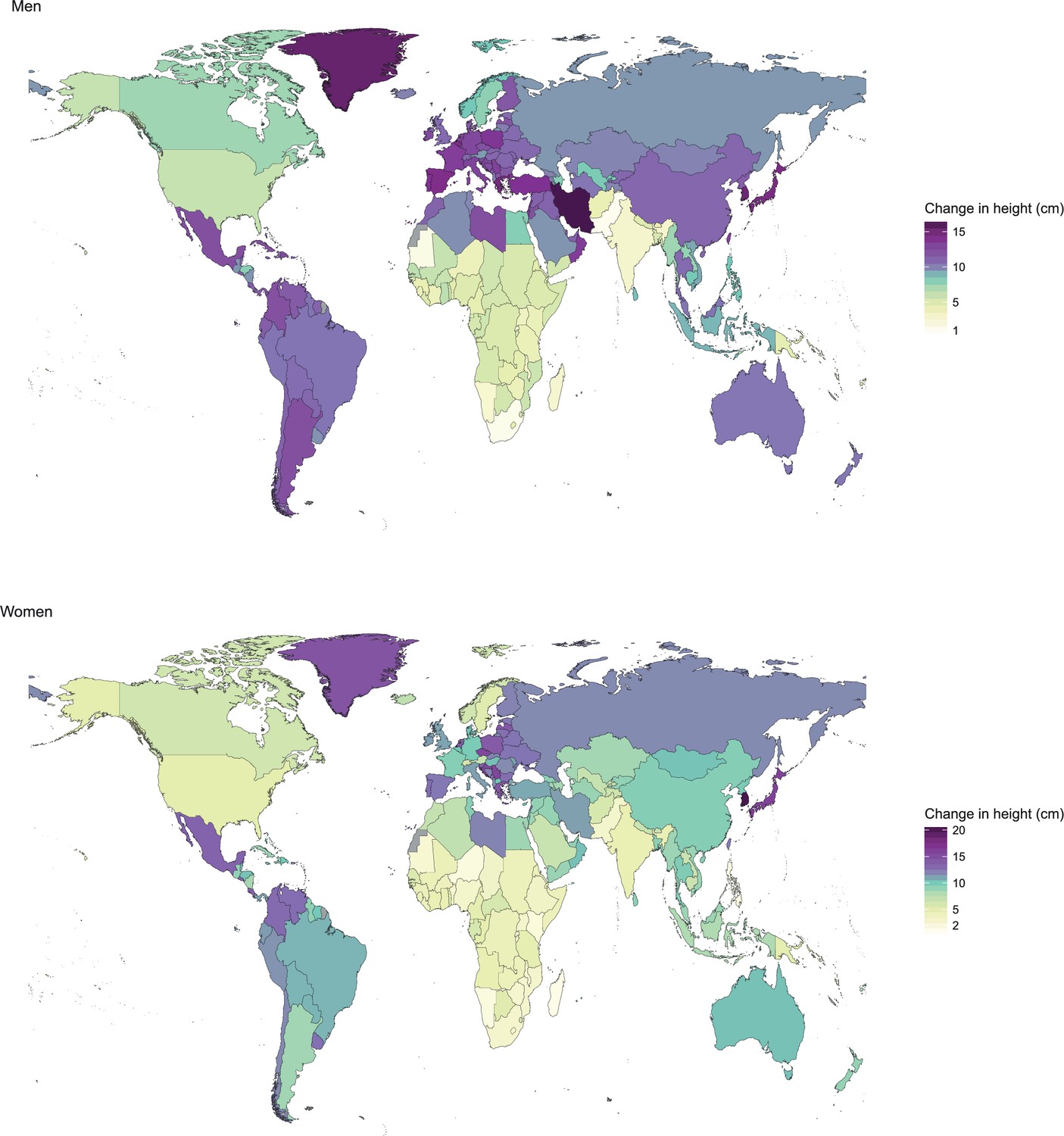
Some notables quotes from this study:
QuoteWe estimated that people born in 1896 were shortest in Asia and in Central and Andean Latin America (Figure 1 and Figure 2). The 1896 male birth cohort on average measured only 152.9 cm (credible interval 147.9–157.9) in Laos, which is the same as a well-nourished 12.5-year boy according to international growth standards (de Onis et al., 2007), followed by Timor-Leste and Guatemala. Women born in the same year in Guatemala were on average 140.3 cm (135.8–144.8 ), the same as a well-nourished 10-year girl. El Salvador, Peru, Bangladesh, South Korea and Japan had the next shortest women. The tallest populations a century ago lived in Central and Northern Europe, North America and some Pacific islands. The height of men born in Sweden, Norway and the USA surpassed 171 cm, ~18–19 cm taller than men in Laos. Swedish women, with average adult height of 160.3 cm (158.2–162.4), were the tallest a century ago and 20 cm taller than women in Guatemala. Women were also taller than 158 cm in Norway, Iceland, the USA and American Samoa.
Average Male Height 100 Years Ago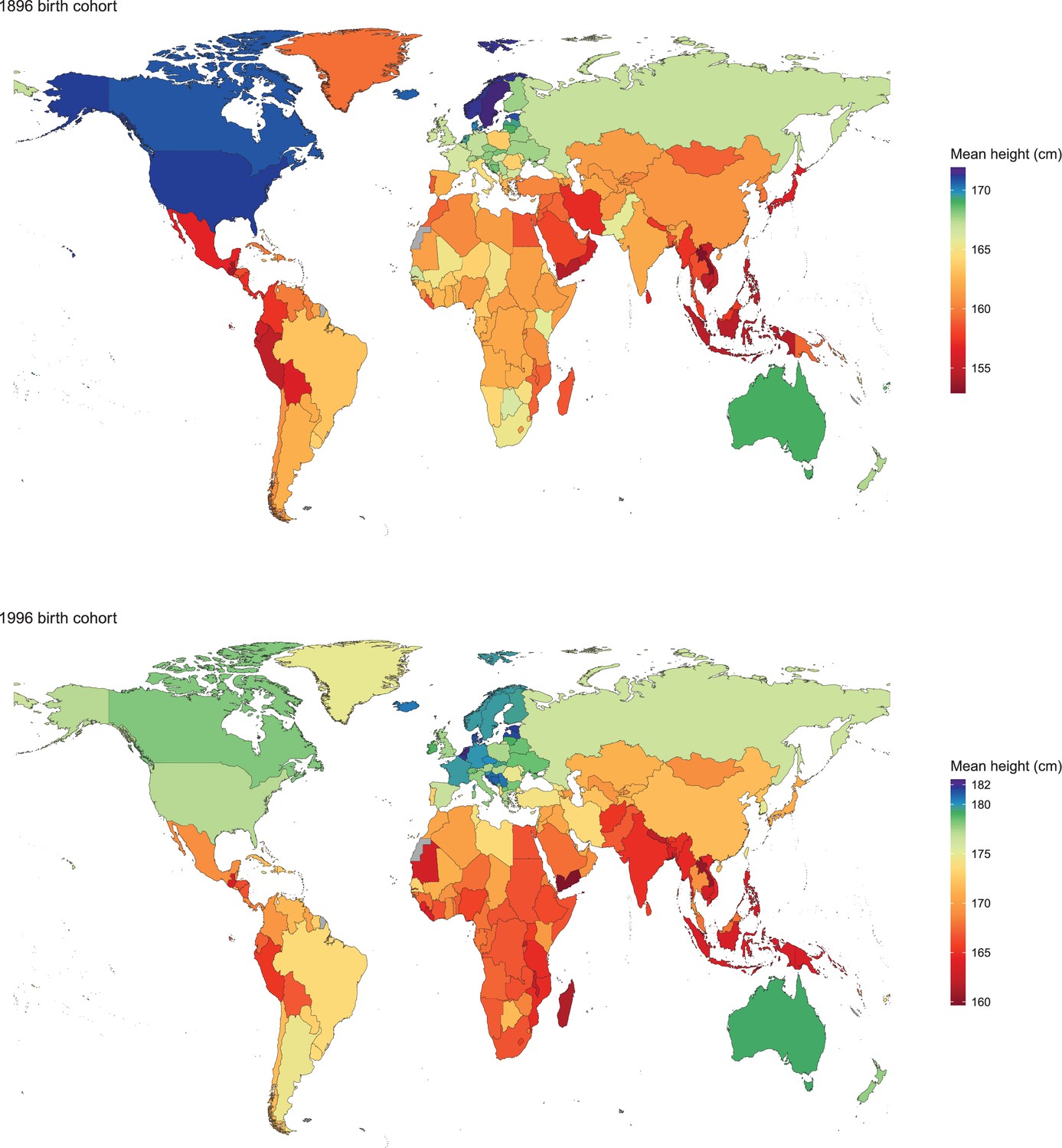
Female Height 100 Years Ago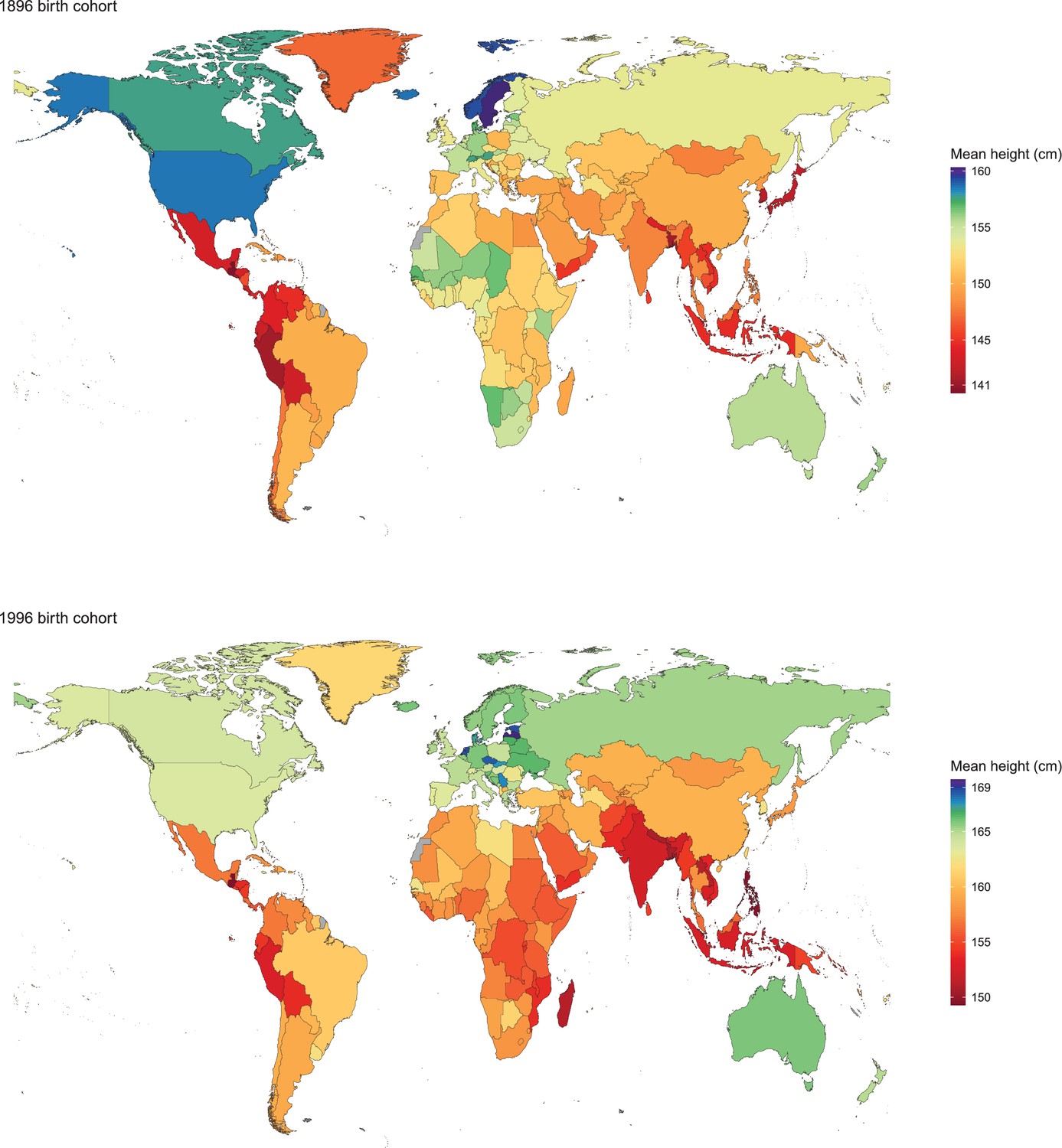
Look at that. Japanese males used to be around 155cm, and females under 145cm. Being around 170cm had you among the tallest in the world. Now the Japanese males average 170cm. Crazy. This will lead us to my next highlights.
QuoteChanges in adult height over the century of analysis varied drastically across countries. Notably, although the large increases in European men’s heights in the 19th and 20th century have been highlighted, we found that the largest gains since the 1896 birth cohort occurred in South Korean women and Iranian men, who became 20.2 cm (17.5–22.7) and 16.5 cm (13.3–19.7) taller, respectively (Figure 3, Figure 4 and Figure 5). As a result, South Korean women moved from the fifth shortest to the top tertile of tallest women in the world over the course of a century. Men in South Korea also had large gains relative to other countries, by 15.2 cm (12.3–18.1). There were also large gains in height in Japan, Greenland, some countries in Southern Europe (e.g., Greece) and Central Europe (e.g., Serbia and Poland, and for women Czech Republic). In contrast, there was little gain in height in many countries in sub-Saharan Africa and South Asia.
On Height Plateauing:
QuoteThe pace of growth in height has not been uniform over the past century. The impressive rise in height in Japan stopped in people born after the early 1960s (Figure 6). In South Korea, the flattening began in the cohorts born in the 1980s for men and it may have just begun in women. As a result, South Korean men and women are now taller than their Japanese counterparts. The rise is continuing in other East and Southeast Asian countries like China and Thailand, with Chinese men and women having surpassed the Japanese (but not yet as tall as South Koreans). The rise in adult height also seems to have plateaued in South Asian countries like Bangladesh and India at much lower levels than in East Asia, e.g., 5–10 cm shorter than it did in Japan and South Korea.
QuoteThere were also variations in the time course of height change across high-income western countries, with height increase having plateaued in Northern European countries like Finland and in English-speaking countries like the UK for 2–3 decades (Larnkaer et al., 2006; Schönbeck et al., 2013), followed by Eastern Europe (Figure 7). The earliest of these occurred in the USA, which was one of the tallest nations a century ago but has now fallen behind its European counterparts after having had the smallest gain in height of any high-income country (Tanner, 1981; Komlos and Lauderdale, 2007; Komlos and Baur, 2004; Sokoloff and Villaflor, 1982). In contrast, height is still increasing in some Southern European countries (e.g., Spain), and in many countries in Latin America.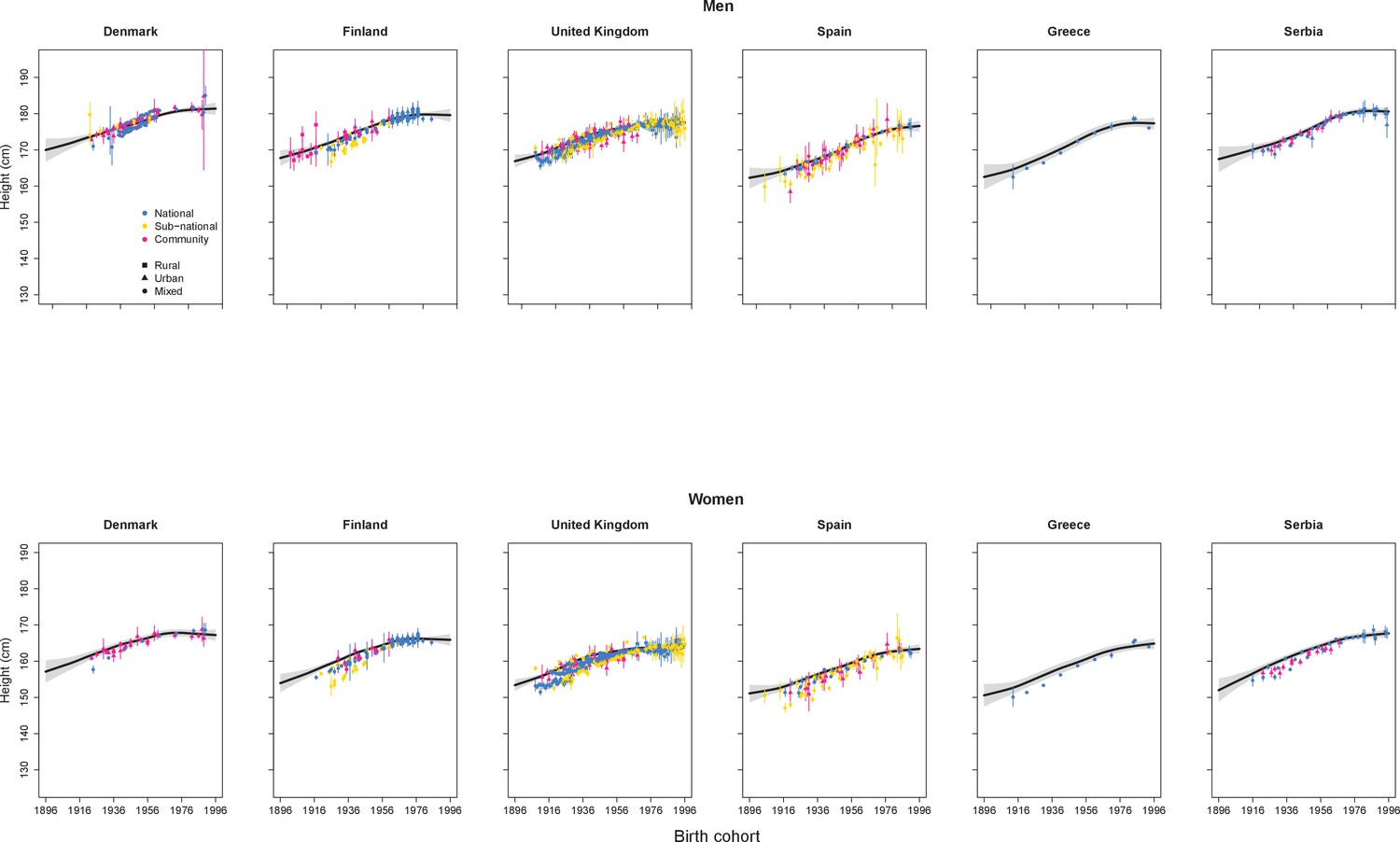
Depending where you live, you won't have to worry about getting significantly dwarfed by future generations. There seems to be a limit to how tall a population can quickly get over the span of a few generations.
Other Trends:
As an exception to the steady gains in most countries, adult height decreased or at best remained the same in many countries in sub-Saharan Africa for cohorts born after the early 1960s, by around 5 cm from its peak in some countries (see for example Niger, Rwanda, Sierra Leone, and Uganda in Figure 8 ). More recently, the same seems to have happened for men, but not women, in some countries in Central Asia (e.g., Azerbaijan and Uzbekistan) and Middle East and North Africa (e.g., Egypt and Yemen), whereas in others (e.g., Iran) both sxxes continue to grow taller.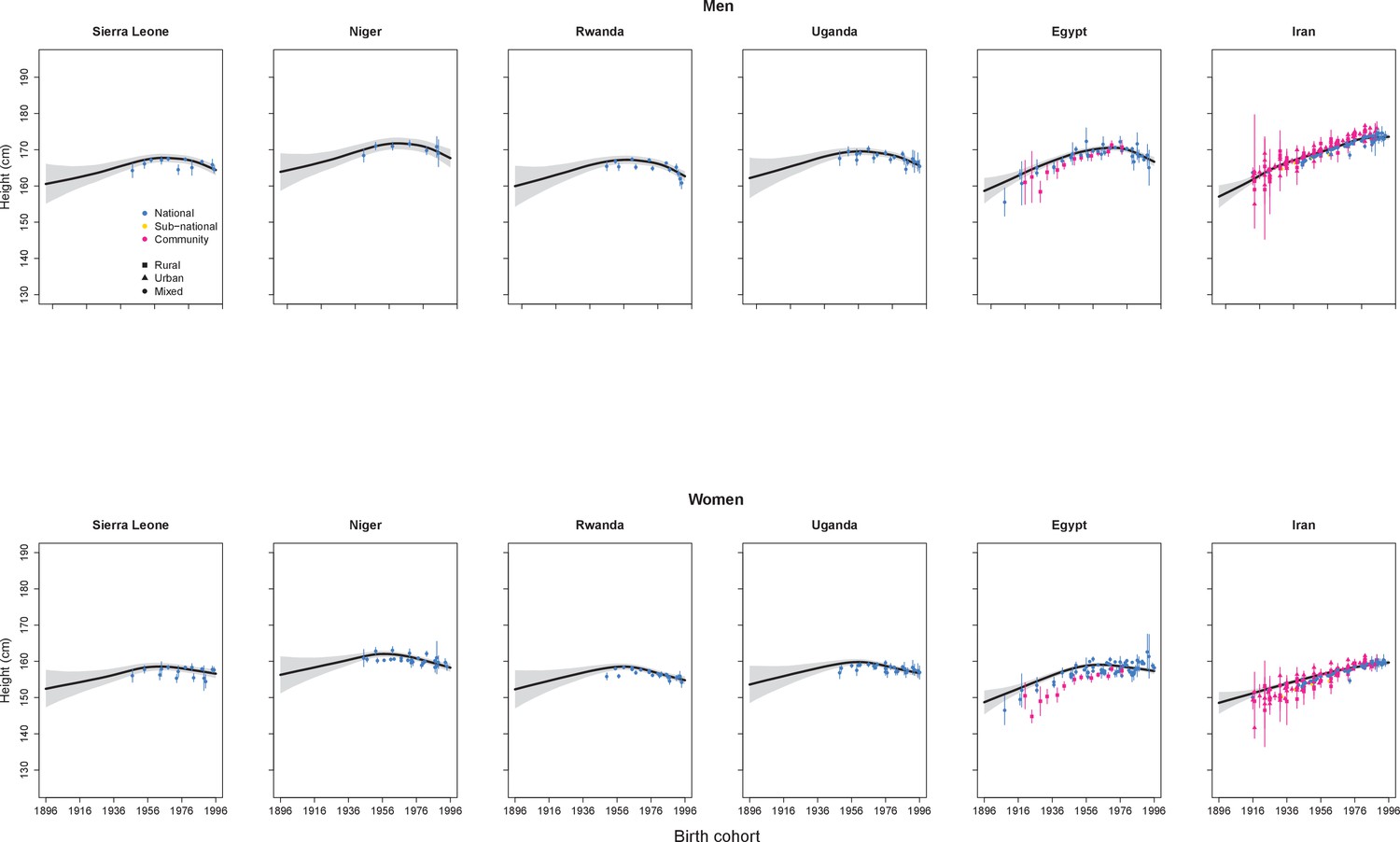
Global Extremes: Then vs Now
Men born in 1996 surpass average heights of 181 cm in the Netherlands, Belgium, Estonia, Latvia and Denmark, with Dutch men, at 182.5 cm (180.6–184.5), the tallest people on the planet. The gap with the shortest countries – Timor-Leste, Yemen and Laos, where men are only ~160 cm tall – is 22–23 cm, an increase of ~4 cm on the global gap in the 1896 birth cohort. Australia was the only non-European country where men born in 1996 were among the 25 tallest in the world. Women born in 1996 are shortest in Guatemala, with an average height of 149.4 cm (148.0–150.8 ), and are shorter than 151 cm in the Philippines, Bangladesh and Nepal. The tallest women live in Latvia, the Netherlands, Estonia and Czech Republic, with average height surpassing 168 cm, creating a 20 cm global gap in women’s height.
Male and female heights were correlated across countries in 1896 as well as in 1996. Men were taller than women in every country, on average by ~11 cm in the 1896 birth cohort and ~12 cm in the 1996 birth cohort (Figure 9). In the 1896 birth cohort, the male-female height gap in countries where average height was low was slightly larger than in taller nations. In other words, at the turn of the 20th century, men seem to have had a relative advantage over women in undernourished compared to better-nourished populations. A century later, the male-female height gap is about the same throughout the height range.
¹
Discuss, if inclined.
Related Medical Evidence Peer-Reviewed
Quote from: IwannaBeTaller on March 17, 2018, 10:04:46 AMThe term "height plateau" is such beautiful soul-bleach to me, I only need to read it and it feels like all my fears of being dwarfed for the rest of my life dissolve...ast least for a while.
Thanks for the post.
That is just incredible. I've never been to these places, but to think that women are only 150 cm tall on average, in the Philippines, is just...very hard to believe?
I don't find it hard to believe it all. But they should be a bit taller in the Philippines due to some of the mixing with Spaniards and the Chinese. Probably like 155cm.
As for Guatemalan women: they were the shortest a century ago, and are still the shortest now. So it follows a logic.
The Asian height trends mentioned in my OP.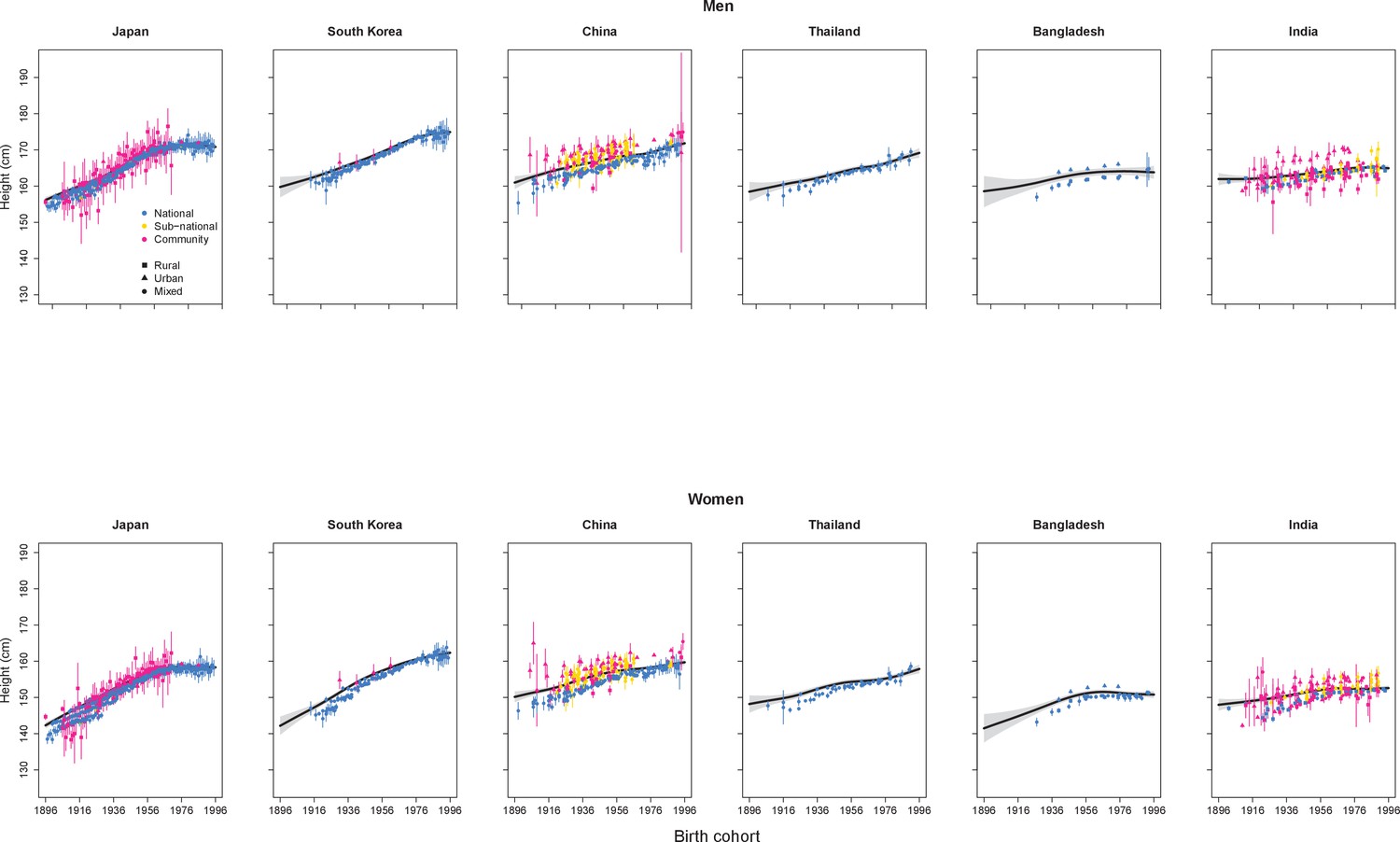
Notice how height in both sxxes has plateaued in Japan, seems to be plateauing in South Korea, and is maybe stagnating in Bangladesh.
However, due to how poor Bangladesh is, I'd be more skeptical to compare it to a country like Japan. India is also literally sub-continental, with many ethnic groups, so the average should be taken with a grain of salt.
There are tall ethnic groups in India itself, despite the stagnation in average height.
Anyway, I think this all proves that height is a formula of genes, good childhood health, good nutrition, and a safe environment - and also over generations. The height decrease in many Sub-Saharan African countries seems to present a strong correlation for that (which is not causation, but y'know). The figure shows a decrease even in Niger, which is mostly a Western African country, where many present day African-Americans can trace their roots from. However, most American studies put African-American males at the same average height as white American males. African-Americans are around 18% European in DNA, but it is hard to believe there could have been such a strong selection for the European height genes in some hundred years in the African-American population.
I think the steady rise in height in places like Japan and South Korea make a strong case for nutrition, health standards and safe environments. Many Sub-Saharan African countries experience a lot of turmoil, poverty, undernutrition, and early childhood disease, so the decrease also seems to follow the logic. In the United States, where this is not the case, African ancestry groups followed the steady rise in height of European Americans.
Avoiding short height in your children will be far easier in the future, but if you want to save money from all the aromatase inhibitors, HGH, and gene therapy you'd need in dire situations... it's easier to guarantee a good, happy, nutritious, safe and stress-free life for your children.
Quote from: CaptainAmerica on March 17, 2018, 05:21:34 PMSorry, you can probably expect 6ft3 to become the average in China in around 30 years due to genetic engineering. But you'll probably be too old to care.
It'll take much more than 30 years. We'll all be dead by the time Chinese parents are illegally genetically engineering their embryos to be as perfect as possible.
There will be newer forms of CLL before clandestine human genetic engineering even really takes off.
Quote from: IwannaBeTaller on March 17, 2018, 10:04:46 AMThe term "height plateau" is such beautiful soul-bleach to me, I only need to read it and it feels like all my fears of being dwarfed for the rest of my life dissolve...ast least for a while.
Thanks for the post.
That is just incredible. I've never been to these places, but to think that women are only 150 cm tall on average, in the Philippines, is just...very hard to believe?
Male height will plateau between 180~195cm in the tallest countries of the world for sure. It'll only keep increasing if men and women in those countries decide to only marry the taller percentiles in their country. Even then, the human body isn't yet ready biomechanically, possibly even biologically (think gigantism's health issues), to increase much further than that. It's not impossible, because evolution is a thing, but it'll take much longer.
Anyway, anyone alive today with a height of 180cm will hardly ever feel height dysphoria at any point in their lives. They'd have to be megalomaniacs who want to tower over even the tallest Dutch guy to feel height dysphoria at such a height. Considering Northern European countries were always among the tallest in the world, and height has plateaued in Finland around 180cm, I highly doubt anyone near that range, and any possible and similarly tall children, will have to worry about feeling short in the foreseeable future.
I know there are some guys here who feel short at 178cm because the average is now 182 or 183cm where they live, but that's not a really big deal. That's the worst height dysphoria is going to get in the tallest countries in the world. Even if height increases a bit further, the gap among people from the same generation will generally remain small (<6cm).
Quote from: IwannaBeTaller on March 17, 2018, 11:09:44 PMI honestly doubt me or even my grandchildren will see a time where 195 cm is the average in any country in the world.
That's the max maximum I can see. A country (or people) could have an average height of around 187cm, and 195cm could be the upper average. Anything above that and you start having problems with biomechanics.
Anyway, like you said, if this ever happens, it'll be long down the road. If Finland has plateaued their height, it's hard to imagine any country quickly getting to that average.
Not entirely related to the thread, but I wanted to post this somewhere.
Quote from: Android on March 18, 2018, 11:29:00 PMWhat a strange idea, since height has no impact when it comes to composing music (especially instrumental). Perhaps the writer of this article has a case of height neurosis too!
What is weird is that it got me thinking why there has been such an increase in height around the world over the last 100 years. Better nutrition over the generations is a huge factor, but why did it not seem to affect aristocracy for so long? Aristocratic families surely would have had good nutrition over their generations.
It could be that it's just a very slow process, but I don't remember men being significantly shorter than 5'1~5'4 (like Grieg and Mozart) thousands of years ago.
Nevermind. I just googled it.
https://www.livestrong.com/article/542877-the-average-height-of-humans-over-time/
https://ourworldindata.org/human-height
It seems height has gone up and down multiple times throughout the ages. Nutrition also seems to be a major factor, despite modern studies parroting it is mostly genetics. I don't even know anything anymore.
QuoteOver the last two millennia, human height, based off of skeletal remains, has stayed fairly steady, oscillating around 170cm [in Europe]. With the onset of modernity, we see a massive spike in heights in the developed world. It is worth noting that using skeletal remains is subject to measurement error with respect to the estimated height and time period.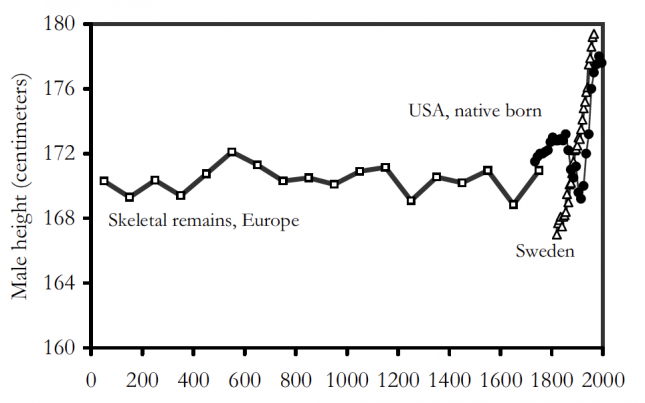
The most massive difference between modernity and older ages really is the better healthcare. So I think the key has to lie in that. Kids and youth who barely get any sick and get good nutrition will reach their maximum (genetic) height potential, which seems to be what happened in developed countries like Japan and Finland.
QuoteHeight did not begin to increase again until the 18th and 19th centuries, according to Steckel. The reasons for this remain unclear, but it is likely that lower temperatures in Europe between the 1300s and the 1800s, combined with higher levels of trade and movement between places, held height down during this period. European emigrants to North America enjoyed a low population density, few disease outbreaks and an increased income and by the 1830s their descendants had reached a peak in terms of height. However, the average height of Americans dropped about 2 inches in the following 50 years, as increased transportation and migration facilitated the spread of disease like whopping cough, scarlet fever and cholera. Heights would not increase again until the end of the 19th century, when government implemented water purification and introduced measures to deal with waste and sewage.
You must be logged in to post a reply.