Dad's height: 180cm
Mom's height: 160cm
Sister's height: 164cm
My final height: 165,5cm
Grandfather from father side: 176cm
Grandfather from mother side: around 163cm
Height at 9 years 3 months: 129cm / 35kg
Height at 11 years 4 months: 138cm / 44kg
Height at 14 years: 152cm /64kg
Height at 18 years: 165cm / 87kg
Very unhealthy food, bad sleeper, stress, and high obesity
TL;DR; 3cm more would mind a lot in this case 
How much height could a man possibly stunt with the worst diet and lifestyle?
Quote from: heightPursuer on March 13, 2018, 06:33:17 PMDad's height: 180cm
Mom's height: 160cm
Sister's height: 164cm
My final height: 165,5cm
Grandfather from father side: 176cm
Grandfather from mother side: around 163cm
Height at 9 years 3 months: 129cm / 35kg
Height at 11 years 4 months: 138cm / 44kg
Height at 14 years: 152cm /64kg
Height at 18 years: 165cm / 87kg
Very unhealthy food, bad sleeper, stress, and high obesity
TL;DR; 3cm more would mind a lot in this case 
Actually, you probably didn't stunt your height at all. Looks like you just inherited your mother and her father's height genetics.
Quote from: heightPursuer on March 13, 2018, 06:33:17 PMDad's height: 180cm
Mom's height: 160cm
Sister's height: 164cm
My final height: 165,5cm
Grandfather from father side: 176cm
Grandfather from mother side: around 163cm
Height at 9 years 3 months: 129cm / 35kg
Height at 11 years 4 months: 138cm / 44kg
Height at 14 years: 152cm /64kg
Height at 18 years: 165cm / 87kg
Very unhealthy food, bad sleeper, stress, and high obesity
TL;DR; 3cm more would mind a lot in this case 
Poor sleep is definitely a factor in stunted height. Deep sleep is when HGH peaks.
Insulin can blunt HGH as well so when you get up in the morning if you eat high sugar or carb breakfasts that can reduce your HGH as well as you start the day.
Quote from: Bigpoppapump on March 15, 2018, 01:35:51 PMPoor sleep is definitely a factor in stunted height. Deep sleep is when HGH peaks.
It is highly unlikely. Human Growth Hormone is released during the slow-wave sleep, which is concentrated in the early hours of the sleep. The last part of the night is important for REM sleep, which affects mood, learning and creativity. So getting less sleep than your body craves is more likely to stunt your mental growth than your physical growth.
Quote from: Bigpoppapump on March 15, 2018, 01:35:51 PMInsulin can blunt HGH as well so when you get up in the morning if you eat high sugar or carb breakfasts that can reduce your HGH as well as you start the day.
While it's true that insulin and growth hormone indeed play antagonist roles against one another starting the day with carbs is perfectly fine since you have a good boost of energy to start the day.
Quote from: CaptainAmerica on March 05, 2018, 04:18:33 AMOkay, now explain how mainland Europe gained on average 3 inches of height in a century, if not for nutrition.
This is a tough nut to crack. For one, height isn't related to just one gene.
Secondly, there's a big association in early childhood health and final height. So it was not only nutrition over the generations, but the fact most kids were being disease and parasite-free.
Bear in mind the study linked here also said height plateaued in countries like Japan, after a big period of growth.
Change in height around the world over 100 years
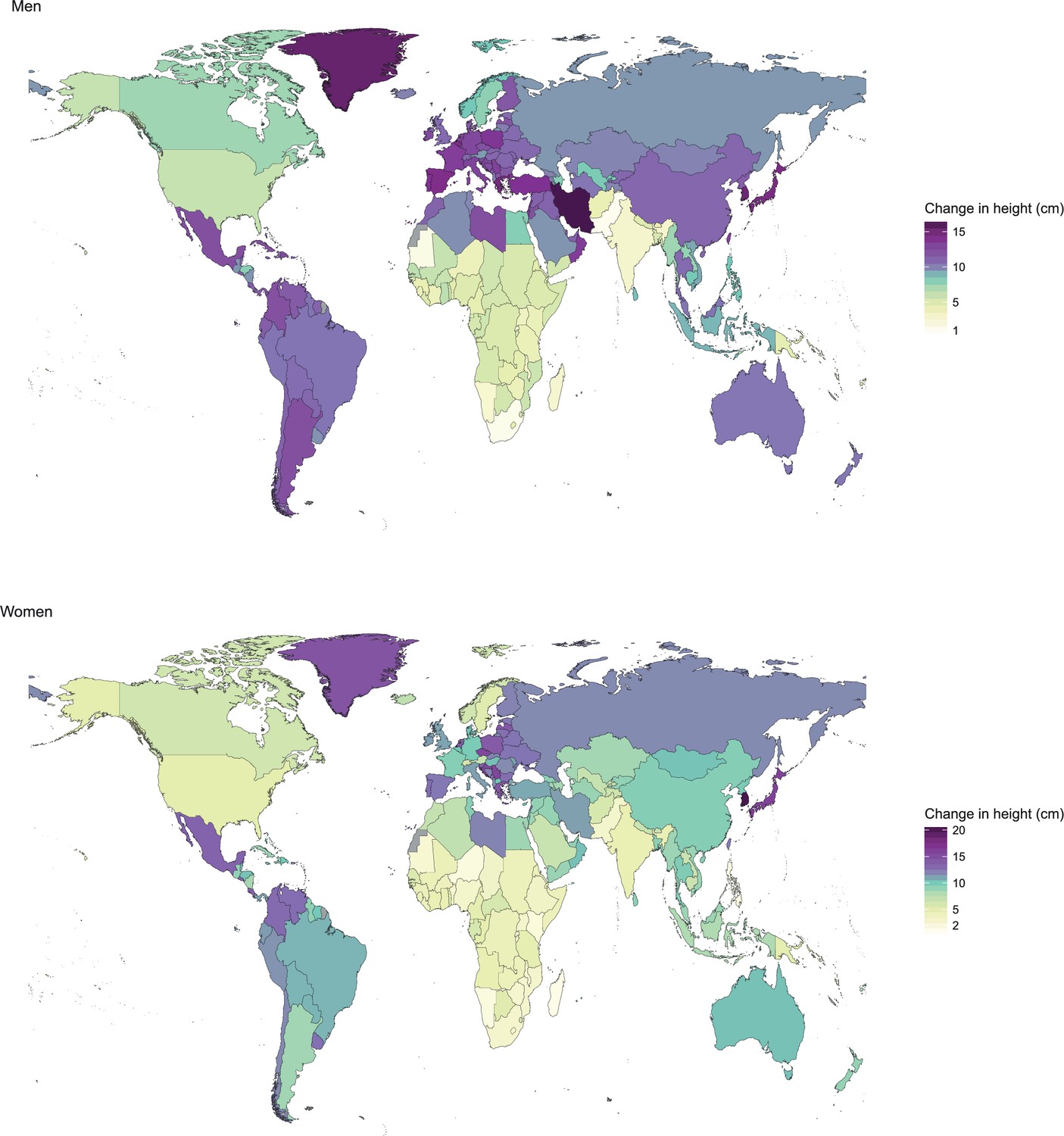
On Japan:
QuoteThe pace of growth in height has not been uniform over the past century. The impressive rise in height in Japan stopped in people born after the early 1960s (Figure 6). In South Korea, the flattening began in the cohorts born in the 1980s for men and it may have just begun in women. As a result, South Korean men and women are now taller than their Japanese counterparts. The rise is continuing in other East and Southeast Asian countries like China and Thailand, with Chinese men and women having surpassed the Japanese (but not yet as tall as South Koreans). The rise in adult height also seems to have plateaued in South Asian countries like Bangladesh and India at much lower levels than in East Asia, e.g., 5–10 cm shorter than it did in Japan and South Korea.
So it seems different peoples (genes, for all intents and purposes) have different peak levels.
Considering the tallest people in the world a century ago are also the tallest people in the world nowadays (the Dutch, Montenegrin, Scandinavians), this is clearly the work of nutrition in association with genetics and better early childhood health.
So, again, the claim that height differences among countries is mostly explained by factors other than genetics is bs.
There's a German member of this forum with a 170cm (5'7) dad and a mother around 160cm who grew to 182cm (~6 feet). This would most likely never happen in a couple of Portuguese, Japanese or Peruvian origin. This seems obviously the result of German genetics, the same genetics that allowed them to get such a big height increase over a century.
What can happen now is that if height starts being heavily sxxually selected for in countries where the height has already plateaued, like Japan, then their average height will probably start increasing little by little, as they'll be selecting for the genes with taller height potential.
Now, this is also all my theory based on all that I've read and observed so far. If an actual researcher on this subject is reading my post and wants to call bs on anything that I said, please do. It'd be highly appreciated and enlighten us all.
tl;dr I think different genes have different peak height potentials. Nutrition, genetics, and early childhood health over the generations are the main factors defining height increase and final height.

Starting the day off with carbs is not a good way to start the day. Breakfast cereals and other similar foods typically give people a dramatic rise in energy followed by a slump in energy that then makes the body tired and causes cravings for more carb foods. People who eat high carb foods first thing in the morning are generally fat.
Regardless of which stage it is released poor sleep will definitely blunt HGH production and potentially stunt a persons growth during the growth years.
I beg to differ regarding your carb statement. If you eat an oatmeal or similar complex carb this won't create such an issue. Fruit is also ok since it has fiber. And fat people are generally fat because they eat too much fat and simple carbs like pure sugar.
What do you mean by poor sleep? Only total lack of sleep have the potential to literally stunt someone's growth. I unlike you have read enough papers to claim this. If you have any scientific information to back up your claim, I'll be happy to read it.
I'm sorry to say but I think I know now for certain that being often sick in your youth and having a low-protein diet will stunt your growth.
This, of course, doesn't mean everyone was actually going to be 6 feet, and just didn't get to that height due to their youth and nutrition. We have had plenty of anecdotal cases here of people with good health during their childhood and high protein diets who still did not become tall. They'd just have been possibly much shorter had everything gone wrong.
If a person is sick all year round maybe. Infections such as diarrhea and helminthiasis are more correlated with stunted growth though. Many people get sick when there is a flu season.
I agree with the diet statement. However, if a person is well fed, even with not necessary high protein diet as long as he isn't starving and have good amount of minerals and vitamins that may no affect growth (at least significantly). When we give examples with poor countries with low protein consumption we have to keep in mind that these people are not nourished, left alone protein fueled.
Quote from: ivan on March 19, 2018, 01:35:33 AMIf a person is sick all year round maybe. Infections such as diarrhea and helminthiasis are more correlated with stunted growth though. Many people get sick when there is a flu season.
I agree with the diet statement. However, if a person is well fed, even with not necessary high protein diet as long as he isn't starving and have good amount of minerals and vitamins that may no affect growth (at least significantly). When we give examples with poor countries with low protein consumption we have to keep in mind that these people are not nourished, left alone protein fueled.
The nutrition aspect is something I'd be willing to pay money to know for sure, but I don't think most nutritionists and endocrinologists really know the finer details between diet and height. Sure, nutrition affects height. We know that much.
However, let's imagine monozygotic twins living in developed nations. One is fed a vegan, high-carb, low-protein diet all his life, and the other is fed a high-protein, average Western diet until his growth plates are closed. What difference could we expect in their heights?
You must be logged in to post a reply.